
Collective Power Structures
Web3 is about creating new checks and balances on power.
This week, we witnessed a Web2 CEO get red-pilled into crypto in real time.
A couple choice tweets:

One of the most interesting points of discussion was a reference to industry-standard APIs and public digital infrastructure. Why do we need an open, immutable database built as a blockchain when we (through industry groups or the government) could all just agree to read/write data in a standardised way?
This touches on a topic that I alluded to in the first Token MBA post: cryptocurrencies, and the broader Web3 movement, is fundamentally about societal organisation and collective power. Dog memes, number go up, and JPG files aside, at its heart is something rather boring: a new model for management.
Management is about human beings. Its task is to make people capable of joint performance, to make their strengths effective and their weaknesses irrelevant
Peter Drucker
There are three primary types of collective power structure that govern our world today:
The Government and the Military: manage human beings through a monopoly on the use of physical violence.
The Church: manage human beings through a monopoly on spiritual violence, with legitimacy established with a central figure or as a collective.
The Corporation: manage human beings through financial incentives distributed top-down from a CEO and Board of Directors.
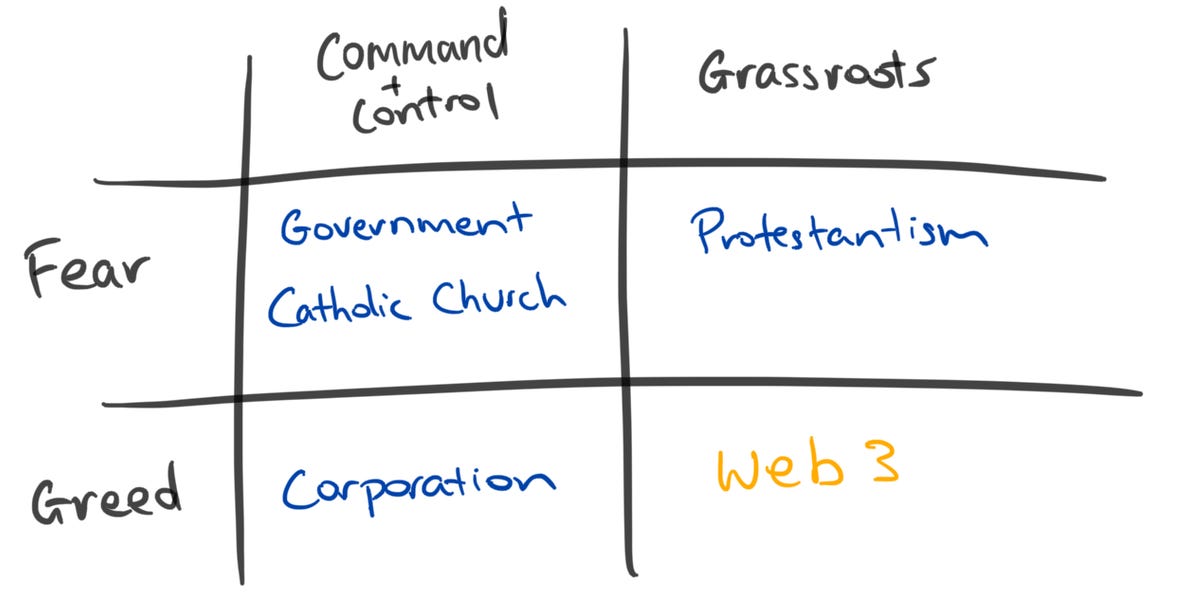
Why should we stop innovating there? All three power structures have contributed to human progress but they all clearly have deficiencies. How can we be sure that these three power structures are all that we need to defeat end-game bosses for humanity like climate change?
Web3 opens up an entirely new design space for management: the peer-to-peer distribution of financial incentives to make people capable of joint performance, mediated by transparent software rather than other corruptible human beings. This new model for collective power is only now possible thanks to:
peer-to-peer transfer of value at scale without intermediaries
the ability to communicate seamlessly (and largely permissionless-ly) online
There has been some recent noise about the potential for peer-to-peer mechanisms to destabilise nation states. The Catholic Church wasn’t a huge fan of Protestants. The gentry didn’t exactly roll out the red carpet for mercantile class. The rise of multinational corporations gutted the civil service around the world.
Whether by accident or by design, societal progress has created a somewhat effective web of checks and balances between our different collective power structures. Web3 introduces a new peer-to-peer power structure into this mix, and we’re about to find out where this power structure has better or worse trade-offs in society.
To bring it back to the tweet above, maybe we’ll find that peer-to-peer owned infrastructure create better trade-offs for society in the management of personal data compared to government-owned or privately-owned cloud infrastructure. I mean, how satisfied are we with the status quo? Global regulatory movements like Open Banking are trying to strengthen checks and balances on valuable data by asking the powerful to place limits on their own power. That never works well.
The best check on power is competition and giving people the freedom to choose an alternative without penalty. I suspect there are a lot of areas of life where we’ve made assumptions about the forever role of government and corporations. Maybe it’s time we revisit some of those assumptions…